


eMail Digg it del.icio.us
ANU Reporter

Dogs, drugs and detection

Spring 2009


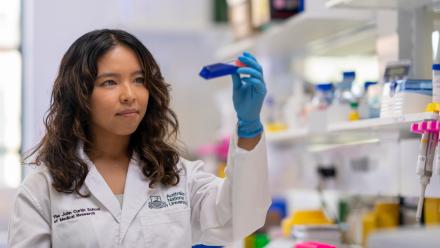
Dr Mal McLeod. Photo: Belinda Pratten
 

A new method for catching sports drug cheating is shaking up the greyhound industry and could have major applications for the human world too. Michael Cavanagh reports on an organic chemist who’s not averse to spending a day at the dog track.

by Michael Cavanagh
 

Hear an interview with Mal McLeod (mp3 / 5.8Mb / 6 mins 20 secs)

The yapping of greyhounds and the noise of the people betting on the outcome of the races seems like a strange setting for a chemist – so what is Dr Mal McLeod doing here?

McLeod, from the Research School of Chemistry at ANU, is leading a team that’s developing a reliable method to identify drugs that have been illegally administered to racing greyhounds by their trainers or owners.

The research program is helping the body that governs greyhound racing in Australia to crack down on the use of steroids within the sport.

McLeod’s work so far has helped the guardians of greyhound racing to successfully prosecute a number of people for the illegal use of steroids in their dogs.

This is in a sport which last year had prize money totalling over $68 million spread across more than 43,000 races.

“There was a big unmet need. Up until now there has been a little bit of testing in the United Kingdom. We are now leading the charge,” McLeod says. “The goal posts have shifted for the trainers; many of them can’t operate the way they used to.”

While testing on athletes and in horse racing has been going on for many years, it was only in July 2008 that Greyhounds Australasia started testing the dogs for possible illegal use of substances such as steroids. This led to the Sydney-based Australian Racing Forensic Laboratory (ARFL) joining forces with ANU to find a foolproof manner in which greyhounds can be tested for steroid abuse.

The ARFL drew up a list of 12 steroid agents which it decided were most likely to be used by trainers and owners and were readily available in Australia.

Many of these drugs are similar to those used by humans and racehorse owners to try and beat the system.

The drugs are presently registered in Australia for human or veterinary use.

Probably the most famous is stanozolol, which became well known after Canadian Ben Johnson tested positive for the drug, following his record-breaking 100 metres run in the 1988 Seoul Olympics. He was subsequently stripped of his gold medal and the record.

Other high profile Olympians caught using performance-enhancing drugs include Linford Christie and Carl Lewis.

Yet despite the increasing success of catching sports drug cheats of the human and equine varieties, the same testing methods do not apply to greyhounds. All this rests on the analysis of metabolites – the products of chemical reactions within an organism when it attempts to break down complex molecules and eliminate them from the body.

The human metabolites of stanozolol do not match the major metabolite obtained when the same drug is administered to greyhounds.

Drugs metabolise differently in humans to greyhounds. Until now nobody performed the research on dogs to work out why.

As part of their experiments, McLeod’s team made a number of new compounds. One of these was called 6 alpha-hydroxystanozolol, which was found to match the greyhound metabolite. This discovery has led to numerous positive swabs for stanozolol doping in greyhounds around the country.

“You have to know what you are looking for, and you need to be able to back that up in the hearing … The sport is definitely cleaner now, that is a fact.”

The team’s work has been part of the task to develop a foolproof method to test for the listed drugs in the urine samples that are mandatorily taken from dogs that finish first, second and third in a race.

To make sure it is foolproof, the nominated list of drugs of abuse was sent by the ARFL to Queensland Racing Science Centre where there are greyhounds used in scientific research.

These dogs were given one of the nominated drugs under veterinary supervision and according to ethical guidelines.

It was then that McLeod’s team stepped in. The researchers have developed compounds – like 6 alpha-hydroxystanozolol – which are tested against the metabolites extracted from the urine from the Queensland greyhounds.

Matching 6 alpha-hydroxystanozolol to a greyhound metabolite sets off a ‘red flag’ and indicates the presence of an illegal drug when testing is carried out.

“It can be a bit of a needle in a haystack finding the correct structure as there is very little of the metabolite that comes from the dog and therefore we have to make an educated guess,” McLeod says.

“With the data that we obtain, there are a number of possible structures that we narrow down to find a match.”

McLeod’s findings mean that the compounds are matched to the different drugs which have been listed by the ARFL. This enables the greyhound racing authorities to confirm that an illegal drug has been found in the specimen taken from a dog that has finished in a place while competing somewhere in Australia.

“You have to know what you are looking for, and you need to be able to back that up in the hearing when the case against the dog’s connections is being held,” McLeod says. “The sport is definitely cleaner now, that is a fact.”

One only has to go to the website Australian Racing Greyhound.com to see how many cases are being prosecuted for illegal use of steroids on dogs by their owners and trainers.

Yet McLeod points out that the increase in successful prosecutions has led people wishing to gain an unfair advantage over their competitors on the greyhound racing circuit to try other substances.

“We are seeing a shift to other drugs because of the successful prosecutions. People are looking to other drugs,” he says. “Once we have finished working through and developing tests for the 12 drugs on the original list, we will look at more exotic agents which could be used for abuse in greyhound racing.”

While this is a relatively new area when it comes to greyhounds and doping, much of the research into human drugs abuse in sport has been done.

“There may be some overlap in our work between dogs and humans. There may be some metabolites which have not been identified. But we are really filling in the gaps there as we are not testing for new agents in humans,” McLeod says.

“The general methods we are using are of relevance to all drug testing. It could also be that some of the metabolites we identify are common to humans or horses and have not been previously identified - this would be a small benefit. We have some ideas for improvements in the identification of metabolites but no concrete results at this stage.”

The future is also not all in trying to identify better ways in which to detect illegal drug use in greyhound racing.

As part of the research, the ANU team is learning more about metabolite structure while working on developing genetically engineered enzymes for the improved synthesis of drug metabolites. The synthesis of drug metabolites is needed by all drug testing – animal and human – and even in areas like pharmaceutical development.

“These techniques will not only be useful in the fight against doping,” McLeod says. “They will have much broader application to areas like drug development in the pharmaceutical industry. We will be able to make the drug metabolites and test them to ensure they do not give rise to toxicity or other side effects.”

Metabolites from pharmaceutical compounds are formed as part of the natural process of eliminating the compounds. Profiling these metabolites plays an important part in helping to show if there are any side effects that could occur from the using of the drug.

His work is expected to result in lowering the costs of producing metabolites that help identify any possible side effects of drugs.

This would enable pharmaceutical companies to carry out more thorough testing on new drugs which are yet to be approved for use in the community.

“Drug companies are already required to understand the metabolism of new drugs before approval. Better and cheaper ways to make the metabolites will enable drug companies to do more thorough testing. This should reduce the risk of adverse outcomes with new drugs,” McLeod says.

Meanwhile, punters can be more confident that the greyhound they are betting their money on is competing in a much fairer environment.

Filed under: ANU Reporter,